French Drain Installation in Fort Wayne, IN
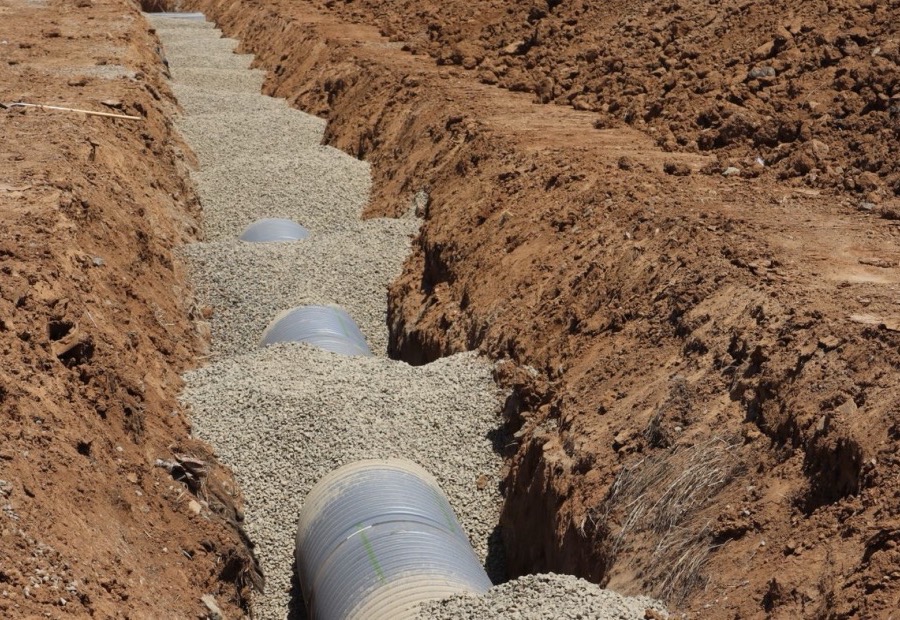
Fort Wayne Drainage Pros digs and installs french drains across Fort Wayne and Allen County, Indiana, for houses and commercial sites. We hold a contractor license and carry insurance. A french drain gives trapped groundwater a way out: a trench, a perforated pipe, washed stone, filter fabric, and a steady fall toward lower ground. Three rivers meet here, and the clay under the yards holds what lands on it.
We run perforated PVC, bed it in washed #57 stone, and wrap the trench in non-woven geotextile filter fabric. Water passes through the fabric. Clay fines do not. The stone keeps its open gaps and the pipe keeps its slots clear. Skip the fabric and the fall, and the trench loads up with clay and quits inside a few years.
A French Drain or a Surface Drain
A wet yard does not always want a buried pipe. A french drain pulls water out of the soil, the water that keeps one strip spongy for days after the sky clears. Water that never sinks in at all is surface water. Regrading or a catch basin handles that one. We name the water first and price the fix second. The wrong tool digs up a lawn and leaves it soaked.
Telling the two apart takes a walk and a soil probe. Surface water ponds in the same low spot every storm and drops as soon as the sun is out. Groundwater shows up as a soft, springy patch with no puddle on it. On Allen County clay a single lot often has both, and that is two fixes, not one.
The Trench and the Slope
We lay the trench along the wet line and give it fall for its whole length. Fall is the engine. Each foot of pipe has to sit lower than the foot behind it. Lay a drain flat and it becomes a buried trough. We shoot the grade as the bucket goes down, because clay ground never looks as flat as it is.
A yard run is usually 12 to 18 inches wide and 18 to 36 inches deep. A run pulling water off a foundation goes deeper, toward the footing, and the cut gets wider so there is room to work. We aim for about an inch of drop every eight feet. That keeps the water moving and still leaves the far end with depth at the exit.
Pipe, Stone, and Fabric
Slots run the length of the pipe, so groundwater gets in everywhere along the trench and not just at one end. The bed is washed #57 stone, angular and clean, so it stacks with big open voids and passes water fast. Non-woven geotextile fabric wraps stone and pipe together and holds the fine clay out. Without that wrap, clay fills the voids. Cheap pit-run gravel carries its own dirt in, and that drain chokes in its first season.
Where the Water Comes Out
A drain is only as good as the place it ends. Where the lot has grade, the pipe runs to daylight and empties itself on the slope. Daylight is the best exit there is, because nothing about it can fail. Flat ground is harder, and a lot of Allen County is flat. There the line ends in a dry well that stores the water while it soaks away, or ties into a sump that lifts it out. We pick the exit first and design the drain back from it.
Close to the rivers the exit takes more thought. Lots near the Maumee, the St. Marys, and the St. Joseph sit over a water table that rises when the rivers rise. An outlet set low on a bank drains fine most of the year and stands underwater when the river is high. We set those outlets higher and fit a flap so nothing backs in.
How the Job Runs
The first visit is a walk of the lot with a probe. We find where the water sits, which way the ground falls, and where a pipe can let out. That last question decides the design, so we answer it first. Then we call in the utility locates, mark the line, and set the grade.
The dig comes next. A mini excavator or a trencher opens the line, and the spoil goes on tarps so the lawn stays clean. Washed stone goes in the bottom. The pipe sets on the stone with the slots facing down. More stone covers it, and the fabric folds over the top to close the wrap. The last few inches are more stone if the drain takes surface water too, or soil and turf if it does not. Then we backfill, rake the strip level, seed or sod it, and clean up. Most runs take one to three days.
The Lawn After the Dig
A trench leaves a mark. Expect a strip of fresh ground the width of the trench, the whole length of the drain. Sod that lifted in whole pieces goes back down and knits in over a few weeks. Clay that came out wet and broke apart gets topsoil and seed, and that strip takes a growing season to blend in.
The strip also settles. Backfilled clay sinks over the first winter, so a line that finished flush can show a shallow dip by spring. A wheelbarrow of soil and a bag of seed puts it right. That dip is not a failed drain.
What It Costs
French drain work prices by the linear foot of trench. Shallow yard runs across open ground sit at the bottom of the range. Deep runs along a foundation, or runs fighting roots, concrete, or a buried line, sit at the top and sometimes past it. A whole job usually lands between about $2,000 and $6,000. A short shallow run with daylight to reach is the cheapest version. Depth, length, and a manufactured exit push it up.
A per-foot figure compares two quotes on the same yard well. It travels badly between different yards. The foot of pipe is the cheap part. Depth, soil, and the exit set the number.
A Short Run and a Long Run
Getting set up costs about the same whether the drain is 20 feet or 200. The machine still arrives, the locates still get called, and the exit still gets built. A short run carries all of that over very few feet, so its per-foot price looks high. A long run spreads the same setup across more pipe, and the per-foot price drops.
Take 60 feet, about what one bad side of a Fort Wayne yard needs. Sixty feet at two feet deep, in open lawn, with daylight to run to, is a one-day job near the middle of the range. Cut it to 30 feet and the total does not halve, because the setup and the exit did not shrink. Stretch it to 120 feet across the same lawn and the total does not double either, because the second 60 feet is only pipe, stone, fabric, and machine hours.
Now change the depth instead of the length. Take that same 60 feet down to a foundation footing. Depth costs more than length does.
What Moves the Number
Soil and depth account for most of the spread. Allen County clay digs heavy and comes out in wet lumps that are slow to move and often not worth putting back. Sand and loam cut faster and backfill cleaner. Depth multiplies all of it. A deeper trench throws more spoil, needs a wider cut, and calls for hand digging tight to a wall.
The exit is the third factor, and people underestimate it. Daylight is nearly free. A dry well means a second pit, a load of washed stone, and fabric around all of it. A sump means a pit, a pump, an electrician, and a discharge line built to survive a Fort Wayne winter. Obstructions are the fourth and cause the surprises: tree roots, a driveway in the path, a fence line, a gas service. Each one means hand digging, boring under, or routing around.
When a French Drain Is the Wrong Fix
We talk people out of french drains regularly, because something cheaper will do the work. If roof water is the source, the answer is burying the downspouts to a pop-up emitter well off the house, not a trench packed with stone. If the ground beside the house has settled and tips back at the wall, regrading is the fix. A french drain earns its price when the water sits in the soil with nowhere to go. Where the water is against the wall itself, the fix is an exterior footing drain.
What a French Drain Will Not Do
A french drain lowers the water in the ground around it. It does not dry out a whole property. Where the lot sits low and the water table runs high, the drain pulls water off the stretch it covers and the rest of the yard stays what it was. A drain cannot move water uphill. With no lower exit, the choices are a dry well or a sump. A dry well needs ground that will still take water. A sump needs power.
Volume is the other limit. Send a whole roof, a neighbor's runoff, and a river-fed water table at one 60 foot run and it will fill and back up. We size the run and the exit to the water we find, and we say when one drain is not enough.
Keeping It Working
A french drain built with stone and fabric asks for very little, because the fabric does the maintenance. Keep the outlet clear. A daylight exit collects leaves, mulch, and mown grass, and a plugged outlet backs up the whole line behind it. Look at it twice a year and after any hard storm. Keep thirsty roots away too. Willows and silver maples hunt water and will find a drain line.
Keep roof water out of it. Downspouts belong in solid pipe running to their own emitter, not tipped into the perforated drain. Feeding a roof into a french drain floods it in exactly the storm you need it working. If a drain does slow down, a camera and a jetter usually find the reason in an hour. The exception is a line silted up without fabric. That clay is in the stone, and no jetter brings it back.
Is there a patch of your yard that stays soft days after the rain stops? Call (260) 386-1098. You get a real person, a walk of the lot, and a written estimate, at no cost. If the roof turns out to be the source, the downspouts get buried while we are there.
How long does a french drain last?
A drain built with washed stone and filter fabric lasts for decades, because the fabric keeps the clay out and the stone stays open. What kills a drain early is leaving those two things out. A pipe dropped in dirt, or in gravel with no fabric, packs with fines and quits in a few years. The materials are what buy the years.
How deep does a french drain need to be?
Deep enough to sit below the water it is catching, and shallow enough that the pipe can still slope down to its exit. Pulling groundwater off a foundation calls for a deeper run than draining a soggy surface. The exit sets the limit, since the far end has to stay above the outlet for the water to keep moving.
Where does a french drain drain to?
To the lowest exit the lot allows. The best is daylight, where the pipe opens on a slope and lets the water out on its own. On flat Fort Wayne lots we run it to a dry well that stores the water while it soaks in, or tie it into a sump that pumps it away. A drain with no exit is just a buried trench that fills up.
Can I put a french drain in myself with gravel?
A gravel-only trench is exactly the drain that fails here. Fort Wayne clay is full of fine particles, and without filter fabric wrapping the stone, those fines wash into the voids and pack the drain solid. Add no slope and the water never leaves. The pipe, the washed stone, the fabric, and the fall all have to be right, or the trench silts up.